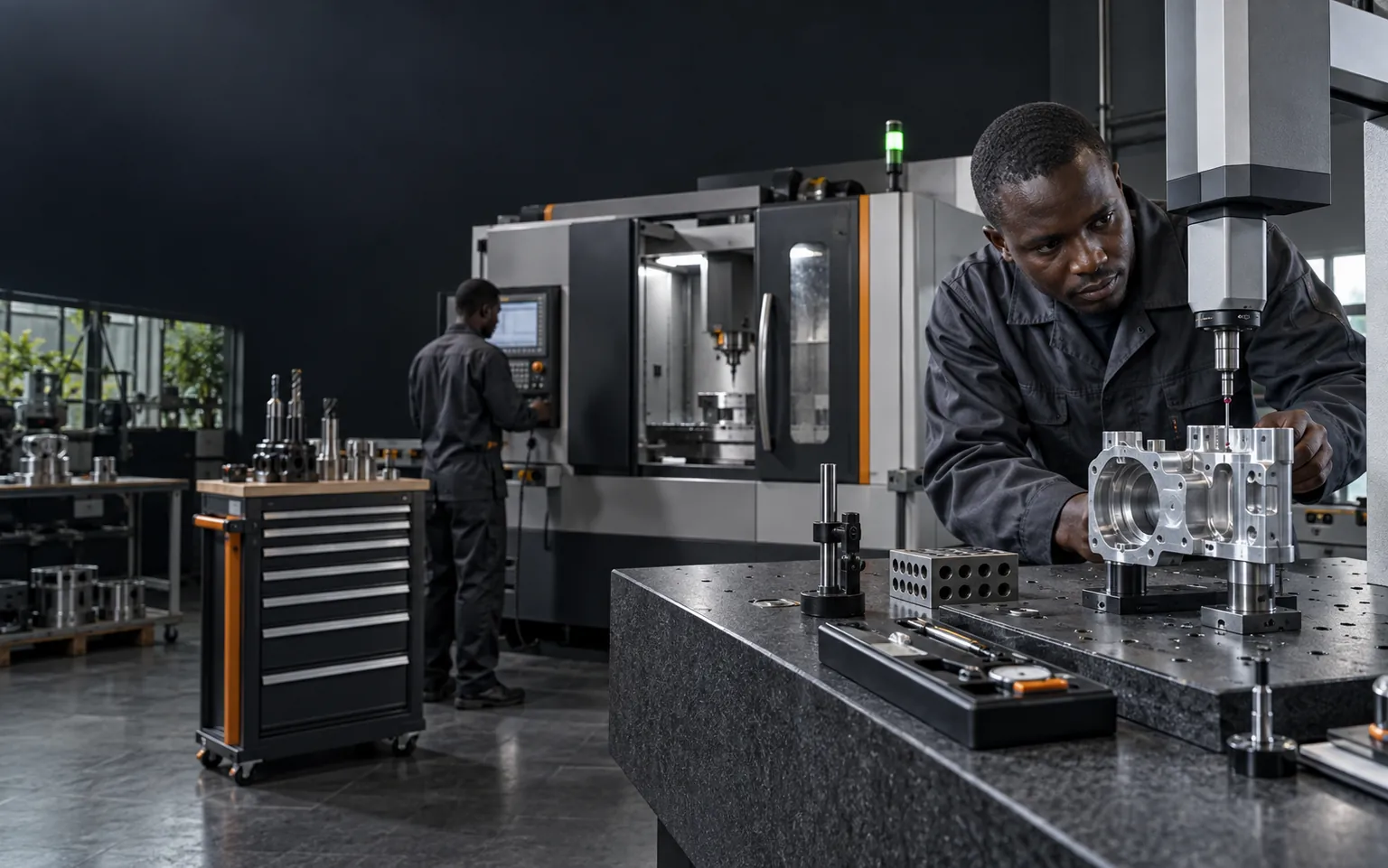
A factory earns its place in the economy each time it delivers an accepted product, at a workable cost, when the customer needs it. Africa’s manufacturing opportunity should be judged by that standard.
The investment case begins with a practical question: which engineering capabilities would make the businesses already operating here more productive—and which of those capabilities can become durable suppliers to a regional market?
For Kenya, candidate applications include food processing, water systems, packaging, power equipment, mobility and material handling. A repeatable supplier of motion assemblies, control systems, fixtures or qualified replacement components could serve several of these markets. The opportunity is to build businesses whose engineering knowledge, customer approvals and production discipline become more useful with every order.
This is SSA’s investment and operating thesis. It is a proposition to test through customer requirements and production evidence, rather than an estimate of guaranteed returns.
Start with the economics of a Kenyan operator
Consider an illustrative processor whose filling line repeatedly stops because an imported mechanism wears prematurely. Buying another identical part may restart production. It does not explain the failure or improve the next operating cycle.
A capable local supplier can investigate the load, alignment, contamination, cleaning regime and maintenance practice; agree a revised requirement; produce a candidate assembly; and test it before installation. The commercial value might be fewer lost production hours, shorter replenishment time or a part that is easier to service. Each claim needs measurement against the existing arrangement.
That is a more useful unit of industrial development than a machine count. An expensive CNC machine with little qualified demand is an underused asset. A supplier with a repeatable process, trained people, inspection records and several paying customers has a business that can justify additional equipment.
The World Bank’s Kenya overview identifies weak productivity growth, a narrow export base and insufficient formal job creation among the country’s challenges. These conditions make firm-level productivity and access to larger markets central to the case for industrial investment. World Bank: Kenya overview ↗
Build the supplier layer around repeatable needs
A systems business should be able to buy a tested motion module, a documented control cabinet, an inspected manifold or a properly specified fixture without recreating every underlying discipline itself. Suppliers need enough application knowledge to challenge an unsuitable specification and enough process control to deliver an agreed revision consistently.
Start with component and process families that share tooling, measurement and engineering knowledge. A positioning axis might support inspection, packaging and machine tending. A power-electronics capability might support motor drives and mobile equipment. A metrology process can improve many parts without requiring the same company to manufacture every one of them.
Commonality must be engineered. Different loads, environments and failure consequences still require application-specific validation. A portfolio of customers reduces commercial concentration; it does not automatically remove a technical single point of failure. Critical assemblies need repair routes, documentation and, where justified, qualified alternative sources.
Give production knowledge a route back into design
A drawing is an agreement about geometry. It is not a complete account of the economics of making the part. A tolerance can determine inspection time, tool wear and scrap; an inaccessible fastener can determine the duration of a field repair.
Customer and supplier should therefore agree the performance requirement, the constraints that cannot change, and the decisions the supplier is authorised to improve. A design review should consider material, geometry, interfaces, available processes, inspection and service access together.
Imagine a water-treatment equipment builder requesting a custom manifold. The supplier might propose standard interfaces, fewer sealing joints and a different machining sequence. The customer retains responsibility for system requirements and approves the change. The supplier takes defined responsibility for manufacturability and part acceptance. Pressure, leakage, compatibility and endurance requirements remain explicit.
The learning is valuable only if it survives the job. Link the requirement to the design revision, material certificate, process settings, inspection result, nonconformance and field outcome. The next quotation should benefit from what the previous job actually cost.
Turn equipment investment into technical careers
Production capacity is inseparable from the people who set up, inspect, maintain and improve it. Kenya should not assume that buying equipment automatically creates this capability. Employers need operators who can follow and improve a process, technicians who can diagnose physical systems, and engineers who can connect requirements to measurement and production.
Kenya's Labour Market Information System reports growing employer demand for combinations of technical, engineering, IT, commercial and management skills in manufacturing. Its evidence is based partly on advertised vacancies, so it describes visible hiring demand rather than every informal or unadvertised need. KLMIS: Key Employability Skills 2024–2025 ↗
The useful response is training connected to real work. An actuator test bench can train an engineer to instrument current, temperature, speed and load. A production fixture can teach repeatability, tolerance and inspection. A maintenance intervention can teach fault isolation and safe recovery. Each exercise should leave a documented procedure and an assessed result.
Industry and training institutions can share equipment, instructors, placements and competency definitions. TVET CDACC describes industry-led occupational standards and curricula as one route for aligning training with work. A company still needs its own task-specific qualification before assigning responsibility for critical equipment. TVET CDACC: industry-led curriculum development ↗
Earn a regional market, one interface at a time
Kenya is a starting point for this thesis. Africa contains distinct industrial systems, currencies, standards and buying processes. A Nairobi supplier, a South African component specialist and a North African export manufacturer will face different customers and constraints. Expansion should follow verified application fit and an executable route to the buyer.
The AfCFTA creates a framework for continental trade. Its rules-of-origin requirements matter when assessing whether a product qualifies for preferential treatment. A manufacturer must check the applicable product rule, documentation and destination requirements rather than treating local assembly as automatic qualification. African Union: rules-of-origin manual ↗
Commercial planning also needs delivery time, border procedures, payment terms, service coverage and working capital. Afreximbank’s 2025 trade report examines African trade amid financial fragmentation and industrial-policy shifts. Our inference is that the supplier’s financing and logistics design deserve as much attention as its production route. Afreximbank: African Trade Report 2025 ↗
Evaluate power at the facility
Kenya’s electricity system offers a material geothermal base. EPRA’s report for the year ended June 2025 records 5,718.15 GWh of geothermal generation. That national resource is relevant to industrial siting; it does not establish the tariff, reliability or available connection capacity of a particular workshop. EPRA: FY2024/25 energy statistics ↗
Before adding a process, measure its demand profile, interruptions, restart losses, cooling needs and backup requirements. A heat-treatment process and a small assembly cell have different power economics. Evaluate the complete operating envelope before committing capital.
Finance each stage against the evidence it can produce
Early engineering needs patient risk capital: prototypes, test rigs, skilled people and trials do not produce dependable loan repayments immediately. Equipment finance becomes more suitable once a production process, orders and repayment capacity can be demonstrated. Working-capital facilities serve a different purpose again: paying for materials and labour while cash is tied up between order and collection.
Contract quality matters. A customer forecast, an unsigned letter of interest and a binding order have different implications. The financing case should explain cancellation exposure, acceptance conditions, payment history, concentration and what happens if commissioning is late.
Currency also belongs in the model. Imported equipment priced in dollars and customer receipts in shillings create a mismatch unless the contract or financing structure addresses it. An attractive factory-level margin can disappear through payment delays, idle capacity or an adverse currency move.
These are proposed underwriting questions for investors and operators. They are not a statement that a particular lender will finance a project. The relevant test is whether the capital creates durable productive capability and whether the business can support its obligations through realistic operating conditions.
Put automation at the actual constraint
Begin with the line’s limiting step. If inspection queues dominate lead time, an additional robot at loading may deliver little. If changeovers consume the shift, fixtures and setup discipline may be the highest-value intervention. If a hazardous or variable task requires automation, evaluate the whole cell: sensing, tooling, controls, guarding, recovery and maintenance.
AI can assist with analysis, inspection and planning. Engineers still need traceable inputs, version control and physical checks. The useful outcome is a better accepted part or a more dependable operation. A persuasive demonstration should report rejected parts and operator interventions alongside throughput.
What makes the capability an asset?
The strongest supplier businesses accumulate things that are expensive to recreate: qualified processes, practical design knowledge, dependable operators, customer trust and a history of measured outcomes. Their software should preserve and apply that knowledge. Their equipment should remove demonstrated production constraints.
Investors should ask whether an expansion improves accepted output, lead time, yield, cash conversion and resilience. A roll-up that weakens engineering staff or eliminates the only alternative qualified supplier can increase fragility even while reported revenue grows. New factories and improvements to existing firms both deserve consideration; each must prove its operating case.
For Kenya and the wider region, the ambition is a network of suppliers capable of improving the physical systems around them. That network can begin with modest, exacting work: a reliable axis, a better fixture, a qualified component, a repeatable test. Capital earns its return when those capabilities become useful often enough to sustain a business.
SSA research / Published 3 October 2026
Source-linked analysis. Company offerings are attributed to their publishers; illustrative scenarios are not measured SSA results.
Discuss a project ↗